




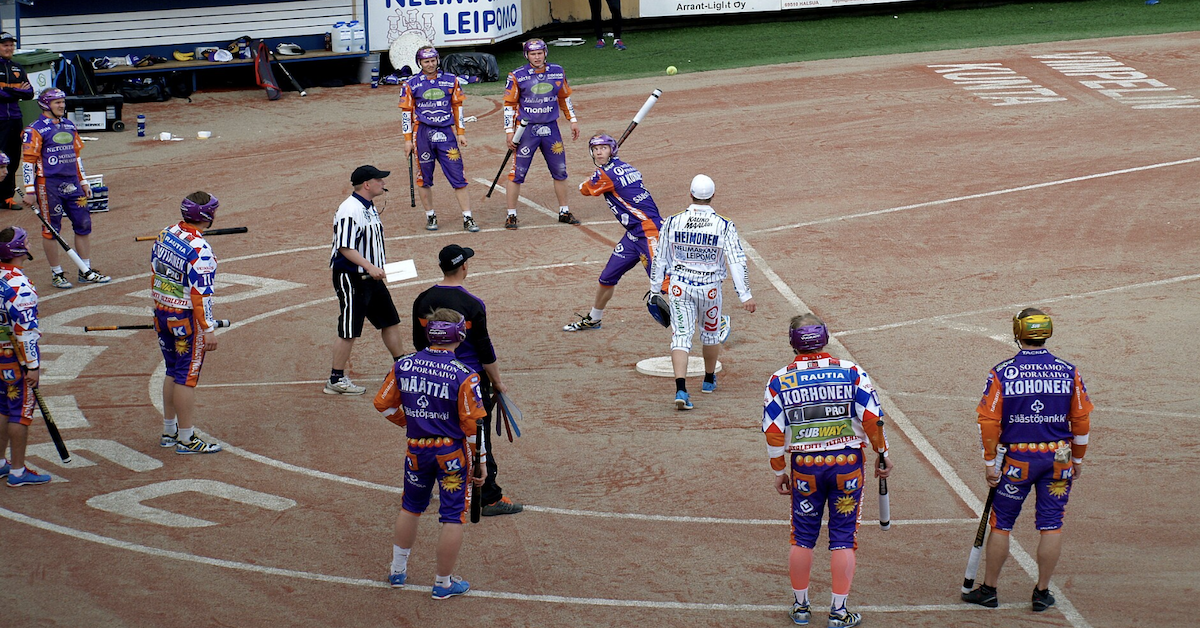
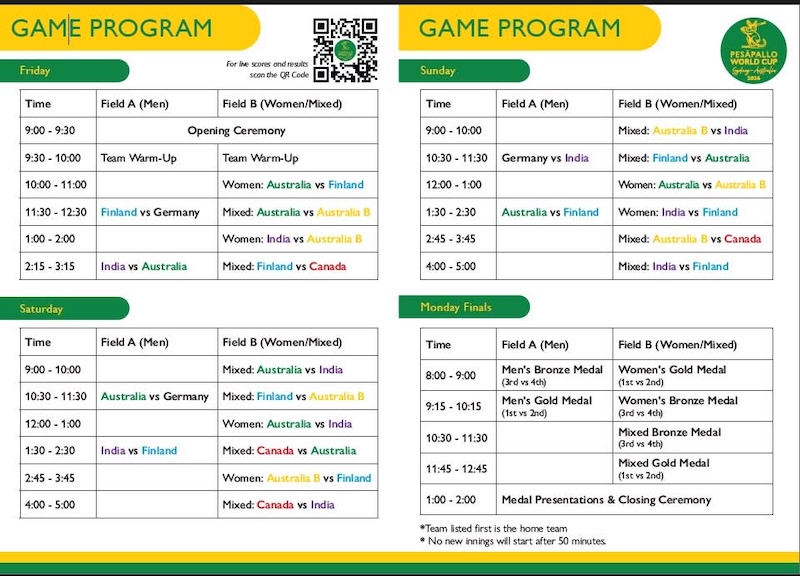
A batter waits at the plate while the pitcher stands almost beside him. Instead of firing the ball towards home, the pitcher tosses it vertically into the air and the batter strikes as it drops. This unfamiliar piece of sporting geometry will be playing out just down the road from Forestville when the 12th Pesäpallo World Cup comes to Lionel Watts Reserve in Frenchs Forest.
The tournament, held from 2 to 5 October 2026, is the latest international chapter for a Finnish game whose rules grew from older European bat-and-ball traditions, American baseball and the ideas of one determined sportsman more than a century ago.

Baseball resemblance ends at the pitch
Pesäpallo is often translated as Finnish baseball, and there are recognisable elements: a batter, fielders, bases, runs and outs. The arrangement changes sharply once play begins.
The pitcher, known in Finnish as the lukkari, delivers the ball vertically beside the batter. Runners do not circle a baseball diamond but move through bases positioned along an irregular route across the field. The Finnish Pesäpallo Association publishes different field layouts for men, women and junior competitions, reflecting a game designed around directed hitting, fast running and tactical movement rather than simply sending the ball as far as possible.
Batters can use their strikes tactically to move runners, while the fielding side tries to catch the ball or get it to a base before a runner arrives. The unusual pitch gives the batter greater control over where the ball is hit, making placement an important part of attacking play.
Finland’s governing body calls pesäpallo the country’s national game. Official competition uses approved bats, balls, gloves and protective headgear, while the sport supports domestic competitions ranging from junior levels to Superpesis, its top league.
A Finnish game built from several traditions
Lauri “Tahko” Pihkala developed pesäpallo from Finland’s earlier bat-and-ball games during the early 20th century. Kuningaspallo was already popular in Finland, but Pihkala also encountered American baseball during trips to the United States and drew ideas from games including Russian lapta, Swedish långboll and German Schlagball.
An experimental match resembling modern pesäpallo was played in Helsinki in November 1920. The earlier game of pitkäpallo was replaced by pesäpallo in 1922, when organised competition also began to take shape. The Finnish Pesäpallo Association was founded in 1931, and the sport subsequently became entrenched in schools and organised competition across the country.
Its World Cup came much later. The first tournament was held in Helsinki in 1992, followed by events in Finland, Sweden, Germany, Australia, Switzerland and India. Sydney will stage the 12th edition in October, following Hyvinkää in Finland in 2023.
Finnish migrants carried the game to Australia
Pesäpallo’s Australian history reaches back much further than the World Cup. A major wave of Finnish migration during the 1950s and early 1960s included people who had grown up playing the sport and wanted to continue it after settling here.

The game became part of the annual Easter Games, later known as the Finnish Festival, bringing Finnish communities from around Australia together for sport and cultural activities. Canberra’s Finnish Society also records pesäpallo being played in Australia since the 1950s and continuing through those community competitions.
Australia has already hosted the World Cup twice, in Melbourne in 2000 and on the Gold Coast in 2012. Sydney therefore becomes the third Australian host when competition begins at Lionel Watts, a few minutes from Forestville.
Published 23-Sept-2026